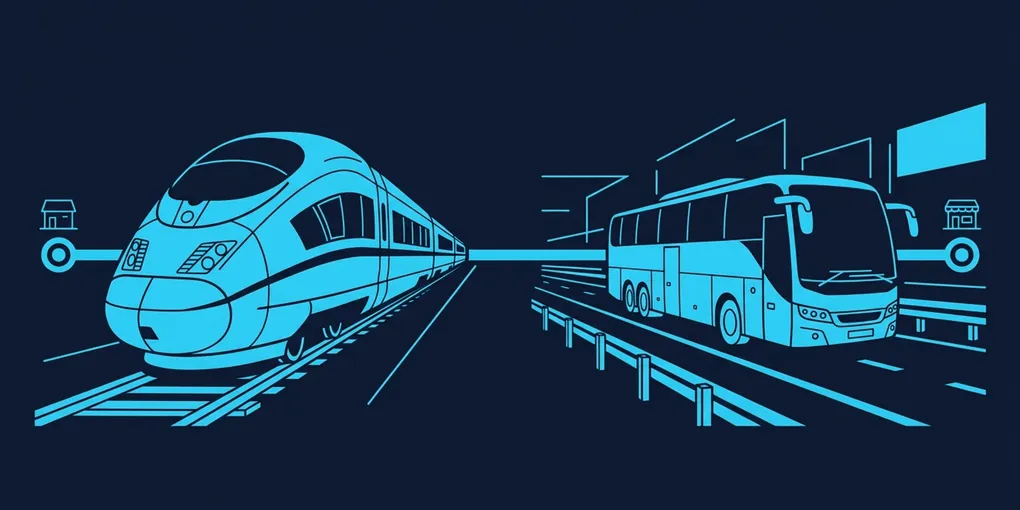
KTX vs bus to Busan: 54,400 KRW buys back two hours
Take the KTX if you want the shortest single trip and don’t mind paying more. Take the 일반고속 (general-class) express bus if the 26,700 KRW one-way fare matters more than the clock. Both run between Seoul and Busan all day, and which one wins depends on how many hours you’re willing to trade for how much won.
KTX vs the express bus, by the numbers
| Mode | One-way fare | Travel time | Terminal |
|---|---|---|---|
| KTX (general/일반실 class) | 54,400 KRW | 2 hours 18 minutes to 2 hours 56 minutes | Seoul Station to Busan Station |
| Express bus, general class (일반고속) | 26,700 KRW | about 4 hours 19 minutes | Seoul Express Bus Terminal (서울고속버스터미널, the Gyeongbu-line side) to Busan Central Bus Terminal (Nopo-dong) |
| Express bus, premium class (우등고속) | 39,700 KRW | about 4 hours 19 minutes | same terminals as above |
The KTX fare in this table is the post-merger price that took effect on September 1, 2026. Before that date the same seat cost 59,800 KRW. Buses run 32 times a day on this route, with the first departure at 01:00 and the last at 24:00, so you’re rarely waiting long for either option even if you show up without a reservation.
One thing the table can’t show: the KTX time range depends on how many stations the train stops at along the way, not on which class you book. A train that stops more often can take 38 minutes longer than the fastest run, for the identical 54,400 KRW fare.
Which one is right for your trip
- If you’re traveling alone and the schedule matters more than the price → book KTX. Even the slowest run at 2 hours 56 minutes beats the bus by well over an hour.
- If you’re on a tight budget and your destination is close to the bus terminal in Nopo-dong → the 26,700 KRW general-class bus is hard to beat.
- If you want a reclining seat and fewer people around you but don’t want to pay full KTX price → the 39,700 KRW 우등고속 (premium-class) bus splits the difference.
- If your actual destination is Haeundae, Seomyeon, or Nampo-dong rather than downtown near Busan Station → factor in the extra transfer from Nopo-dong before you decide the bus is cheaper. It might not be, once you count your own transfer time.
What changed on September 1
KTX and SRT stopped operating as two separate systems on September 1, 2026. SRT services now run under the KTX name, and reservations for both go through one app, Korail’s 코레일+. That merger is also why the fare dropped: the combined operator cut the Seoul-Busan general-class fare from 59,800 KRW to 54,400 KRW, a reduction the announcement described as roughly a 10% average cut across routes.
Tickets for any KTX departure from September 1, 2026 onward went on sale starting August 5, 2026 at 10:00 AM, through the 코레일+ app and Korail’s website.
The bus side is moving in the other direction. South Korea’s transport ministry announced on August 26, 2026 that intercity and express bus fares would rise by about 9% starting October 1, 2026. Operators had asked for a bigger increase, closer to 20%, but the ministry approved less than half of that. If you’re booking a bus trip for October or later, expect the 26,700 KRW and 39,700 KRW fares in the table above to be somewhat higher by the time you travel; the exact new figures were not set as of this writing.
What a 3-night, 4-day trip actually costs
Say two people are doing a 3-night, 4-day trip and taking the same mode both ways. Round trip by KTX comes to 54,400 KRW each way, times two people, times the round trip: 217,600 KRW total for both of you.
The same trip on the general-class bus is 26,700 KRW each way, times two people, times the round trip: 106,800 KRW total.
That’s a difference of 110,800 KRW for the pair, over four fares.
For one person traveling alone and wanting the reclining premium bus instead of the cheapest option, the round trip on 우등고속 runs 79,400 KRW.
Put another way, the 110,800 KRW you save by taking the bus over the KTX, for two people round trip, is close to two extra nights in a mid-range guesthouse. If your itinerary is loose enough that spending roughly two more hours each way doesn’t cost you anything you actually wanted to do in Busan, the bus pays for itself. If those two hours would otherwise be spent at Haeundae Beach or in a Busan market, the math tips the other way and the time is worth more than the won.
Two traps that catch first-time visitors
The bus doesn’t go to Busan Station. It ends at the Busan Central Bus Terminal in Nopo-dong, which sits toward the north end of the city, connected to Nopo Station on the subway. If your actual destination is Haeundae, Seomyeon, or Nampo-dong, you’re adding a subway or bus transfer that a KTX traveler arriving at Busan Station, closer to the city center, doesn’t need. Factor that transfer into your time comparison, not just the terminal-to-terminal 4 hours 19 minutes.
The KTX fare doesn’t reward booking the fastest train: every seat in general class costs 54,400 KRW regardless of whether the run takes 2 hours 18 minutes or 2 hours 56 minutes. If you book the first available departure without checking its duration, you could end up paying the same fare for a trip that’s 38 minutes longer than it needed to be. Check the listed travel time before you confirm, not just the departure time.
How to book each one
- For KTX or the former SRT trains (now KTX-산천), book through the Korail global English site or the 코레일+ app. Both trains now appear in the same unified booking system.
- If you’d rather use the SRT-branded interface during this transition period, it’s still running in parallel and accepts the same routes.
- For either general-class (일반고속) or premium-class (우등고속) express buses, book through the national bus reservation site, which supports English, Chinese, and Japanese as well as Korean.
- Arrive with your booking confirmation ready. Seoul Station and Seoul Express Bus Terminal are both large enough that finding the right platform or gate takes a few extra minutes the first time.
Official links:
- Korail global English site (KTX and KTX-산천): https://www.korail.com/global/eng/main
- SRT English booking (parallel service during the transition): https://etk.srail.kr/main.do?language=EN
- Express bus reservations (Korean, English, Chinese, Japanese): https://www.kobus.co.kr/main.do
Where to book
Book KTX and KTX-산천 tickets directly through Korail’s global English site, or through the 코레일+ app once you have a Korean phone number or are comfortable with the English web interface. Book express buses through the national reservation site linked above, which handles both 일반고속 and 우등고속 fares from the same search. If you’re comparing prices across booking platforms before you commit, check the options below.