Hangang Bus: 3,000 KRW one-way, and the Climate Card question
A one-way ride on Seoul’s Hangang Bus costs 3,000 KRW for an adult, 1,800 KRW for a teenager aged 13 to 18, and 1,100 KRW for a child aged 6 to 12. Whether a short-term Climate Card pass gets you aboard is the one thing Seoul’s pages do not agree on: the city’s price table lists the Hangang Bus as not included in those passes, while the operator’s FAQ says the short-term pass “remains usable.” Budget the fare separately and carry a card that can buy a single ticket at the pier, because cash is not accepted anywhere in the system.
What a ride actually costs
Hangang Bus sells single tickets by age group, and a round trip is exactly double the one-way price.
| Rider | One-way | Round trip |
|---|---|---|
| General (adult) | 3,000 KRW | 6,000 KRW |
| Teen (13–18) | 1,800 KRW | 3,600 KRW |
| Child (6–12) | 1,100 KRW | 2,200 KRW |
There is no senior discount. The official FAQ states this plainly: “경로 우대 할인 요금은 없습니다.” If you are travelling with an older relative expecting a transit-style senior fare, this route does not have one.
A change to the adult fare is under discussion, but nothing has been decided. A Herald Business report of 2026-09-12 says the city is looking at keeping the weekday price at 3,000 KRW and raising the weekend fare, quotes surveyed residents as accepting a rise of roughly 1,000 to 2,000 KRW, and puts a public hearing on September 29 with any change starting no earlier than April 2027. The hearing has not been held. Every price above is the one in force now.
What Seoul’s price table says about the short-term pass
Seoul sells short-term Climate Card passes in five lengths, and the city’s own fee table for them ends with the same line for every single one: “따릉이와 한강버스가 미포함” (Ddareungi bike share and Hangang Bus are not included).
| Pass length | Price | Covers Hangang Bus? |
|---|---|---|
| 1-day | 5,000 KRW | No |
| 2-day | 8,000 KRW | No |
| 3-day | 10,000 KRW | No |
| 5-day | 15,000 KRW | No |
| 7-day | 20,000 KRW | No |
That table alone would settle the question. It does not, because Hangang Bus runs its own FAQ that answers a related question differently, and the two pages do not point the same way.
Two official pages, two different answers
One FAQ entry on the Hangang Bus site is titled, in the original Korean, “[대중교통 요금] 기후동행카드 사용이 가능한가요?” Its answer separates three products: the prepaid 30-day Climate Card, which stopped taking top-ups on August 31 and remains usable through September 29; the postpaid Climate Card, whose discount applies to September usage before it reverts to an ordinary postpaid transit card; and the short-term pass, about which the answer says only “(기후동행카드 단기권) 지속 이용 가능합니다.”
That last line can be read two ways: it can mean the short-term pass keeps being sold, or it can mean the pass keeps working for rides, including this one. Hangang Bus does not say which reading is correct anywhere else on its site.
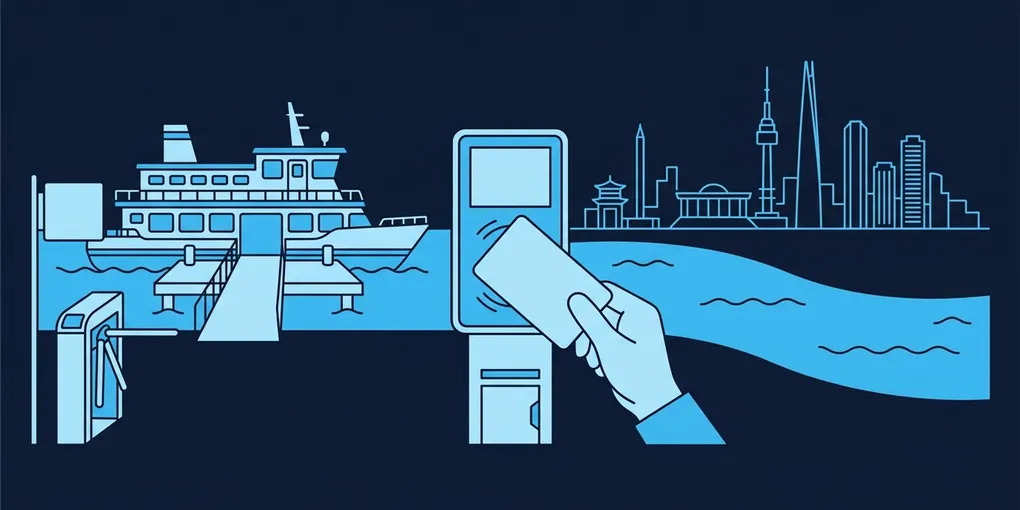
A separate FAQ answer adds a second data point without resolving the first: “한강버스 탑승 게이트에 티머니 태그기가 설치돼 있어 교통카드 및 기후동행카드를 통한 결제가 가능합니다.” A T-money tag reader sits at the boarding gate, and payment works through a transit card and a Climate Card. The Korean word used is 기후동행카드 without naming which product (30-day, postpaid, or short-term), so this sentence does not confirm the short-term pass taps in either.
Neither page says what actually happens when you tap a short-term pass against that gate reader. One widely shared English-language guide skips past this entirely, describing payment as working with “a Climate Companion Card or T-money” and transfer discounts “just as they do on buses and the metro,” without separating short-term from monthly cards.
Treat that kind of blanket line with caution: it is not something either official Hangang Bus or Seoul city page confirms. Carry a way to pay for a single ticket at the pier vending machine as backup, since that purchase is confirmed to work regardless of which reading of the FAQ turns out to be right.
Where first-time riders lose money or time
No cash, anywhere. The FAQ is direct: “현금으로 결제는 불가하며, 교통카드 또는 기후동행카드가 없으시다면 편의점에서 티머니 교통카드(3,000원)를 구매하여 충전 후 사용해 주시기 바랍니다.” Vending machines and boarding gates both take cards only. If you land without a transit card, a T-money card costs 3,000 KRW at any convenience store, and you top it up separately.
Oksu and Apgujeong sit next to each other on the map, but they are not one stop apart: the two piers alternate service rather than both appearing on the same run, “운항 효율성과 안전성을 고려해 옥수와 압구정 선착장은 교차해 정차한다.” The departure timetable’s own footnote confirms it: “※ 옥수-압구정간 직항 노선은 미운항 합니다.” No boat sails direct between them.
The Seoul Forest pier is temporary and can queue on weekends. It runs only “운영기간 : 2026년 6월 8일~10월 말” with “운항횟수 : 하루 16회 정차,” tied to a garden expo. On weekends, riders there also draw numbered tickets to board: “주말에는 임시선착장 이용객도 대기표를 뽑아야 한다,” and “한 시간 전부터 대기표를 배부하는데 늦게 오면 탑승이 어려운 경우도 있다.” If your trip falls after late October 2026, confirm this pier is still running before you plan a stop there.
Numbered-ticket boarding is not limited to Seoul Forest, either. A weekday-afternoon gate at Yeouido was observed managing boarding the same way: “잠실행 한강버스 탑승 시작하겠습니다. (게이트) 외부 줄 (탑승객들은) 한 손에는 번호표, 한 손에는 카드 준비해주세요.” Whether this runs at every departure or only when it is busy is not stated, so treat it as something you may encounter rather than a fixed rule at every pier.
Is Hangang Bus the way you should cross the river
- If you’re riding once for the trip on the water itself, not to connect into buses or the subway, → the 3,000 KRW single ticket at the pier vending machine is the whole cost; no pass changes that.
- If you already hold a 1-, 2-, 3-, 5-, or 7-day Climate Card pass for buses and the metro, → budget the Hangang Bus fare separately. The short-term pass price table lists Hangang Bus as not included.
- If your dates fall after the end of October 2026, → check whether the Seoul Forest pier is still operating before you route through it.
- If you specifically want to travel between Oksu and Apgujeong, → this is not a one-stop shortcut; no direct sailing connects the two.
- If you’re carrying only cash, → change your plan before you reach the pier. Vending machines and boarding gates both take cards only.
What a family of four actually pays
Take two adults, one teenager, and one child, each making the same round trip. Two adults doing a round trip is four one-way fares; the teenager and child each do two one-way fares for their own round trip.
That comes to 17,800 KRW for the group, for the boat ride alone. It does not include getting to the pier or onward from it. A Climate Card pass covers those connections, just not this leg.
The route itself runs in two directions rather than as a loop: westbound from Magok through Mangwon to Yeouido, and eastbound from Yeouido through Apgujeong, Oksu, Seoul Forest, and Ttukseom to Jamsil, with Yeouido as the transfer point between the two. Riding the full line one-way, end to end, covers seven timed segments: Magok–Mangwon 21 minutes, Mangwon–Yeouido 26 minutes, Yeouido–Apgujeong 29 minutes, Apgujeong–Oksu 9 minutes, Oksu–Seoul Forest 15 minutes, Seoul Forest–Ttukseom 14 minutes, and Ttukseom–Jamsil 15 minutes.
Add those up and the full Magok-to-Jamsil run takes 129 minutes. Boats run 40 times a day between 11:00 and 21:39, on the same schedule on weekends and holidays, across eight piers in total: Magok, Mangwon, Yeouido, Apgujeong, Oksu, Seoul Forest, Ttukseom, and Jamsil. The current timetable has applied since 2026-08-15, with no end date set beyond further notice, and boats carry either 199 or 155 passengers depending on which vessel is assigned to the run.
How to actually get on
- Check the fare and route you want on the official fare page, then look at the timetable image for that day’s departure times from your pier.
- If you don’t already carry a transit card, buy a T-money card (3,000 KRW) at a convenience store near the pier and top it up before you board.
- Buy a single ticket at the pier’s own vending machine (card payment only), or tap your transit card or Climate Card at the boarding-gate T-money reader.
- Watch for numbered-ticket boarding at busy piers, especially Seoul Forest on weekends, and arrive with time to spare rather than right at departure.
- If Oksu or Apgujeong is your destination, double-check which one your boat actually calls at before boarding, since the two alternate rather than both stopping every run.
Official links:
- Fare table: https://www.hgbus.co.kr/itc/information/fee?menuId=33
- Official FAQ: https://www.hgbus.co.kr/posts/3?menuId=12
- Route map and timetable: https://www.hgbus.co.kr/itc/information/schedule?menuId=32
- Pier list: https://www.hgbus.co.kr/itc/information/wharf?menuId=24
- Climate Card short-term pass fee table (Seoul city notice): https://news.seoul.go.kr/traffic/archives/510651
- Seoul Forest temporary pier notice: https://mediahub.seoul.go.kr/archives/2018407
Where to book
There is nothing to pre-book here. Hangang Bus has no reservation app. The FAQ says so directly: “예매를 위한 모바일앱은 없습니다.” A single ticket is a physical ticket bought at the pier’s own vending machine on the day, valid only at the pier where you bought it and only for that day.
If you’re counting on 모두의카드(기후동행패스), romanized Modu-ui Card, the residency-based monthly refund program that is separate from the short-term Climate Card passes above, know that it does not apply to you as a visitor. The city’s own notice describes it as “거주지를 기반으로 하는 대중교통비 환급 지원 사업” and states “서울 시민만 적용대상이며,” with refund thresholds of 100,000 KRW for the Plus tier and 62,000 KRW for the Regular tier for general users, or 90,000 KRW and 55,000 KRW for youth. Without a Korean residential address, there is no sign-up to make, so the only thing worth carrying to a Hangang Bus pier is a card that can pay for a single ticket or tap the gate reader.
Sources I checked
- Hangang Bus official one-way fare pageKorean source
- Seoul city notice, Climate Card short-term pass fee tableKorean source
- Hangang Bus official route-map image, "Westbound and Eastbound Operations" labelKorean source
- Hangang Bus official departure timetable image, footnoteKorean source
- Hangang Bus official pier list pageKorean source
- Hangang Bus official vessel specifications pageKorean source
- Herald Business report on the proposed weekend fare rise, not yet decidedKorean source
- Korea.kr government explainer article on transit-fare refund thresholdsKorean source
- Hangang Bus official FAQ, no reservation app plus single-ticket rulesKorean source