Flying Korean Air or Asiana? You need Incheon Terminal 2
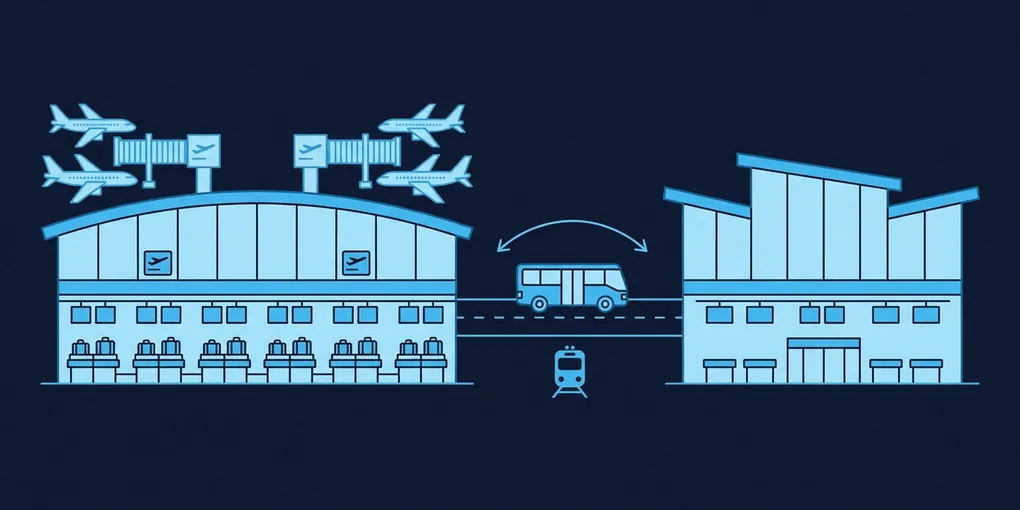
Korean Air, Asiana Airlines, Jin Air, Air Busan, and Air Seoul all check in and depart from Incheon’s Terminal 2. Every other airline, including most foreign carriers, still uses the older Terminal 1; that’s where you go unless your specific airline tells you otherwise. The two buildings sit far enough apart that guessing wrong costs you real time, so check your airline against the list below before you leave for the airport.
Which airlines actually moved to Terminal 2
Terminal 2 opened on 2018-01-18, and Incheon has been shifting more Korean carriers into it ever since. The moves that matter for a trip booked today:
| Airline | At Terminal 2 since | Where to check in |
|---|---|---|
| Jin Air | 2023-07-01 | Terminal 2 check-in hall |
| Air Busan | 2025-07-29 | Terminal 2 check-in hall |
| Air Seoul | 2025-09-09 | Counters E1 through E10 |
| Asiana Airlines | 2026-01-14 | Counters G through J |
| Korean Air | already resident | Counters open at 05:30 |
Counter opening times matter as much as the terminal itself. Korean Air’s Terminal 2 counters open at 05:30, and Asiana’s open at 05:00. If you’re flying one of the foreign airlines that also use Terminal 2, their counters open 2 to 3 hours before departure rather than at a fixed clock time, so build your morning around your own flight time rather than someone else’s.
If your airline isn’t on that table, don’t assume it’s automatically at Terminal 1. Codeshare and joint-operated flights use the terminal of the airline that actually flies the plane, not the one whose name is printed on your ticket.
Deciding if you ever need to switch terminals
- If you’re flying Korean Air, Asiana, Jin Air, Air Busan, or Air Seoul → you need Terminal 2, full stop.
- If your ticket says one airline but was booked as a codeshare → look up which airline actually operates the flight, then match that airline’s terminal, not the one on your booking confirmation.
- If you land on one airline and have a separately ticketed connection on another → check both flights’ terminals separately, because your arrival terminal and your departure terminal are not guaranteed to match.
- If neither leg of your trip touches the five airlines above → you’re almost certainly at Terminal 1, but confirm it on Incheon’s own terminal finder rather than trusting a blog post.
- If you’re only picking someone up or dropping them off → match the terminal to their flight, since arrivals halls are also split between the two buildings.
Getting from one terminal to the other
Sometimes you can’t avoid a same-day switch: an arriving flight into one terminal and a connecting flight out of the other. Incheon runs two ways to make that move.
| Method | Time | Cost | How often |
|---|---|---|---|
| Free shuttle bus, Terminal 1 to Terminal 2 | about 15 minutes | free | about every 10 minutes, 05:00 to 23:00 |
| Free shuttle bus, Terminal 2 to Terminal 1 | about 18 minutes | free | about every 10 minutes, 05:00 to 23:00 |
| Airport railway (AREX) between terminals | 6 minutes | 1,050 KRW | — |
Budget for the worst case, not the best one. If you catch the shuttle bus right as it leaves, you wait roughly another 10 minutes for the next one on top of the ride itself.
That’s up to about 25 minutes door to door on the free option, against 6 minutes plus 1,050 KRW on the train. If your connection is tight, pay the 1,050 KRW.
Where outdated advice still gets people lost
- English-language guides have not all caught up with Asiana’s move. As of this year, one widely read self-transfer guide still lists Asiana under Terminal 1, and a Korea travel blog updated as recently as mid-2026 doesn’t mention the move at all. A separate site that does track it correctly puts Asiana at Terminal 2 “since January 14, 2026.” Don’t take any single blog’s terminal list at face value; cross-check it against the airport’s own airline lookup.
- The shuttle train that connects the two terminals for transfers, as opposed to the free bus for people who’ve already cleared arrivals, does not let you get off partway or turn around. Incheon’s own transfer guide states plainly that once you board, you cannot go back. Make sure you’re heading toward the terminal you actually need before you step on.
Parking for more than a quick drop-off
If you’re driving yourself and leaving the car for a multi-day trip, the choice between short-term and long-term parking is not close, and the rates are identical whether you park at Terminal 1 or Terminal 2.
| Short-term parking | Long-term parking | |
|---|---|---|
| First 10 minutes | free | free |
| Base rate | 1,200 KRW for the first 30 minutes | 1,000 KRW per hour |
| Additional time | 600 KRW per extra 15 minutes | included in the hourly rate |
| Daily maximum | 24,000 KRW | 9,000 KRW |
Say you’re away for a typical short trip, three nights and four days, and the car sits in the lot the whole time.
Long-term parking for four days runs 36,000 KRW. Park in the short-term lot by mistake for the same four days and you hit the daily maximum every day.
That’s 96,000 KRW, or 60,000 KRW more than the long-term rate for the exact same car in the exact same time. Unless you’re parking for only an hour or two, walk to the long-term lot.
Checking in before you even reach the airport
Incheon’s downtown city airport terminal at Seoul Station lets you check bags and clear security before you board the train out, skipping either terminal’s check-in counters entirely. The cutoff depends on which terminal your flight actually departs from.
| Your flight departs from | Seoul Station check-in closes |
|---|---|
| Terminal 1 | 3 hours before departure |
| Terminal 2 | 3 hours and 20 minutes before departure |
Miss that window and the city terminal option is gone; you check in at the airport itself instead. For airlines with strict counter cutoffs, that matters too. Jeju Air, for one, closes its own airport check-in 60 minutes before departure, so a missed downtown check-in can turn into a genuinely tight connection.
Confirm your terminal before you leave home
- Look up your flight number on Incheon’s own airline and terminal search rather than a search engine result: https://www.airport.kr/ap_ko/881/subview.do
- If you have a same-day connection between the two terminals, read the official transfer procedure first, since the shuttle train route only runs one way once you board: https://www.airport.kr/ap_ko/931/subview.do and https://www.airport.kr/ap_ko/937/subview.do
- For the free shuttle bus and the AREX option between terminals, check current timing here: https://www.airport.kr/ap_ko/997/subview.do
- If you’re driving and leaving your car, compare current parking rates before you park: https://www.airport.kr/ap_lp/ko/tpt/parinf/parfeeinf/parfeeinf.do
- If you plan to check in at Seoul Station instead of at the airport, confirm the cutoff for your specific terminal: https://www.airport.kr/ap_ko/893/subview.do
- Read Asiana’s own notice on its Terminal 2 move if you’re flying with them, since it also covers codeshare exceptions: https://m.flyasiana.com/C/KR/KO/customer/notice/detail?id=CM202509300002526502
None of this takes more than a few minutes, and it’s the difference between walking straight to your gate and running a shuttle bus schedule with a boarding pass in hand.
Where to book
If you’d rather not think about terminals at all once you land, book ground transport that already knows which building your flight uses. A private transfer or a pre-booked airport taxi takes your flight number and drops you at the right terminal automatically, which matters most if you’re flying one of the airlines that moved to Terminal 2 in the last year or two and your own itinerary still shows the old information.
Sources I checked
- airport.krKorean source
- airport.krKorean source
- airport.krKorean source
- airport.krKorean source
- jejuair.net
- airport.krKorean source
- m.flyasiana.com
- incheontimes.co.krKorean source