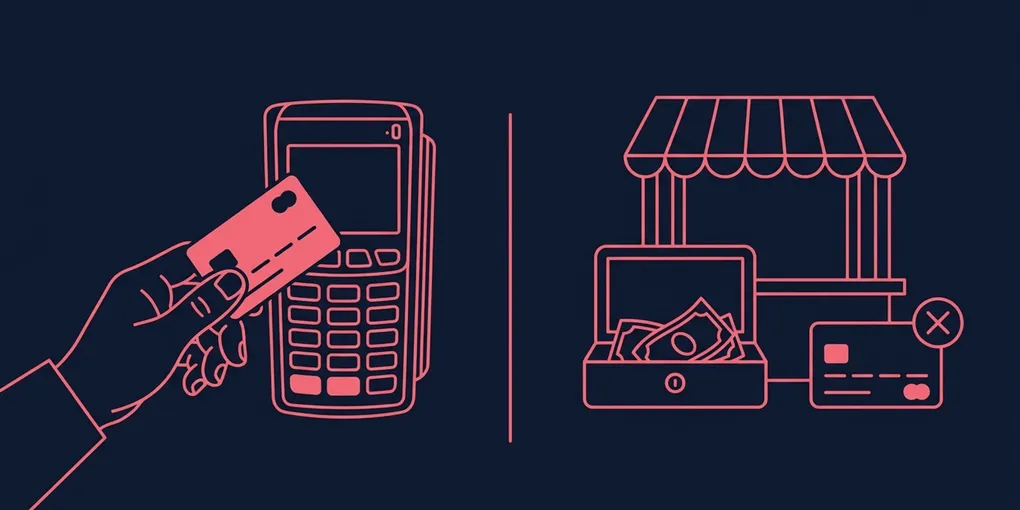
A card refusal over 5,000 KRW is worth reporting. Here's the payout.
If a business in Korea refuses your card for anything between 5,000 KRW and 50,000 KRW, report it to the National Tax Service within one month and you get a flat 10,000 KRW back — more than double what the refusal cost you. Refuse to pay a card surcharge in a taxi and the driver is the one risking a fine, not you. Below 5,000 KRW, don’t bother; the reward tiers don’t reach that low. This article works through the numbers so you know which side of that line you’re on.
What you actually get for reporting a refusal
Korea’s National Tax Service pays a reward to anyone who reports a business that refused a card payment or tried to pass its card fee onto the customer. The payout scales with how much you were refused, not with how annoyed you were:
| Refusal amount | Reward | Filing window |
|---|---|---|
| 5,000–50,000 KRW | 10,000 KRW flat | Within 1 month of the refusal |
| 50,000–1,250,000 KRW | 20% of the refused amount | Within 1 month of the refusal |
| Over 1,250,000 KRW | 250,000 KRW flat | Within 1 month of the refusal |
Two limits sit underneath that table. The reward is capped at 1,000,000 KRW per person per year, and any calculated reward under 1,000 KRW isn’t paid at all. Neither limit matters much on a single trip: the annual cap alone works out to four maximum-tier reports before you’d hit it.
Notice that the top of the middle tier and the bottom of the flat tier line up exactly: 20% of 1,250,000 KRW is 250,000 KRW, which is also the flat reward that starts the moment you cross that amount. The program doesn’t leave a gap where reporting suddenly gets worse for you.
There’s a separate, smaller program for a different problem: a disguised merchant (a business processing your card under a different company’s name, usually to dodge fees). Reporting one of those pays a flat 100,000 KRW per case, before a 22% withholding tax that brings your actual payout to 78,000 KRW. That’s a rarer situation for a short trip, so the reward tiers above are the ones worth knowing before you land.
Is filing worth it for you?
- If you were refused for less than 5,000 KRW → skip it. A 4,800 KRW taxi fare or a 3,838 KRW roll of gimbap refused on its own doesn’t clear the reward program’s floor.
- If the refusal was between 5,000 KRW and 1,250,000 KRW → file with the National Tax Service. The smallest possible reward still doubles a 5,000 KRW loss, and it only gets better from there.
- If you don’t have a Korean resident registration number → go straight to the National Tax Service (Hometax or 126), not CREFIA’s consumer line. CREFIA’s formal complaint channel asks for the first six digits of a resident registration number, which most foreign tourists don’t have.
- If you’re due to leave Korea within the next few weeks → file before you go. The one-month window runs from the date of the refusal, not from your arrival or departure date, so a normal tourist trip doesn’t put you anywhere near that deadline.
- If a taxi driver tells you the card machine is broken → treat it as the refusal this article is about, not a technical excuse. The law doesn’t recognize “broken machine” as a reason to turn away a card.
How much cash to actually carry
There’s no official recommended cash amount from any Korean government source. Nothing from the Bank of Korea or the tourism ministry sets a number for visitors. What you can calculate from verified prices is a floor, not a target: a Seoul taxi’s base fare is 4,800 KRW and a roll of gimbap at a Seoul snack shop averages 3,838 KRW, so 8,638 KRW covers one of each in a single cash transaction.
Multiply that daily floor out over a typical three-night, four-day trip and you get 34,552 KRW as a minimum cash buffer for the whole stay, not what you’ll spend, just what keeps a cash-only moment from stranding you.
That buffer matters less than it used to. The Bank of Korea’s most recent survey put cash at 17.4% of payments nationwide, down 4.2 percentage points from 2021, with the average person’s monthly cash spending falling to 324,000 KRW, a 36.0% drop over the same period. Cards are winning by a wide margin. The gap that’s left is where this article lives: small vendors, older card terminals, and unmanned machines that don’t like foreign-issued cards.
Where foreigners get caught out
Three things trip up visitors specifically, in the first few days of a trip rather than after a long stay:
- CREFIA’s complaint line needs an ID number you don’t have. The Credit Finance Association’s consumer center (CREFIA, 여신금융협회) is the industry body that handles card-service complaints, and its formal channel asks for your name, phone number, the first six digits of a resident registration number, and the merchant’s details. Without a resident registration number, that channel is effectively closed to a tourist. Use the National Tax Service instead.
- 120 is the wrong number. Some pages point foreign visitors to Seoul’s 120 non-emergency line (다산콜) for a card-refusal report. Seoul’s own official FAQ says otherwise: report to CREFIA (02-2011-0700) or the National Tax Service (126), not 120.
- A traditional market stall may charge you more for using a card. A reported case at a Yongin market in May 2026 had a vendor adding what amounted to a 10% surcharge for card payments, pricing cash and card differently for the same item. That kind of fee pass-through sits in the same category the law prohibits for card refusals outright.
Beyond those three, foreign-issued cards are also reported (on travel forums, not in any official source) as being declined at unmanned machines like public parking pay stations, Hi-pass toll top-up units, and some parking-app kiosks. No source explains why, so treat it as a reason to keep cash on hand for machines with no human behind them, not as a confirmed technical fact.
The taxi drivers who claim “no card machine”
A driver refusing your card isn’t a quirk of the vehicle — it’s a penalty risk for the driver personally, confirmed on identical terms by both Seoul’s and Incheon’s city pages:
| Offense (driver, Seoul & Incheon) | Fine | License consequence |
|---|---|---|
| 1st | 200,000 KRW | Warning |
| 2nd | 400,000 KRW | 10-day suspension |
| 3rd | 600,000 KRW | 20-day suspension |
Seoul goes further for the taxi company itself, though this half of the penalty is confirmed only on Seoul’s page, not Incheon’s: a 60-day business suspension on the first offense, 90 days on the second, and 180 days on the third.
Underneath both penalty schedules is a national law, separate from either city’s rule: 여신전문금융업법 (the Yeoshin Financial Business Act), Article 19, bars refusing a card payment or treating a card-paying customer worse than a cash-paying one because of it. Violating it carries up to one year in prison or a fine of up to 10,000,000 KRW. A driver waving you off with “card doesn’t work” is choosing to risk that, usually to dodge the card fee, not stating a fact about the vehicle.
If you do report a driver through CREFIA rather than the tax service, know that its penalty ladder for a pure card refusal (as opposed to a fee pass-through) is a warning on the first violation, a contract-termination notice on the second, and possible termination from every card company’s network on the third.
How to file, step by step
- Note the date, the amount refused, and the merchant’s name and address at the time it happens. The one-month clock starts on the transaction date.
- For the reward itself, file with the National Tax Service through Hometax or by calling 126, referencing the reward-for-reporting-card-refusal rules: https://www.nts.go.kr/nts/cm/cntnts/cntntsView.do?mi=2476&cntntsId=7800
- If you’d rather go through the industry body instead (and you have a resident registration number), CREFIA’s consumer center handles it in about 2-3 weeks: 02-2011-0700, or https://customer.crefia.or.kr
- For anything you’re unsure how to route in Seoul specifically, the city’s own FAQ confirms the correct channels are CREFIA and the National Tax Service, not 120: https://opengov.seoul.go.kr/civilappeal/2895804
One more thing worth knowing before you file: a 2026 tax-reform proposal would raise the annual reward cap from 1,000,000 KRW to 10,000,000 KRW. As of today, that change has not taken effect. The 1,000,000 KRW cap still applies, and while some media reports mention filings from the start of next year, that start date isn’t confirmed in the National Tax Service’s own announcement. Don’t plan around a cap that isn’t live yet.
Where to book
Nothing here is a product. Filing a card-refusal report costs nothing: you do it yourself through Hometax, by phone at 126, or through CREFIA at 02-2011-0700, and none of those channels charge a fee to use. Carrying cash is the same: you get it from your own bank, an ATM, or a currency exchange before or during the trip, at whatever rate they offer that day. There’s no booking step to add here, and no reason to route you through one.
Read the numbers again before your trip, not after a bad exchange with a market vendor or a taxi driver. A refusal under 5,000 KRW isn’t worth the form. One over that, and the math already works in your favor — a 10,000 KRW flat reward at minimum, rising to 20% the larger the amount, filed within a month through a channel that doesn’t ask a tourist for an ID number they don’t have.
Sources I checked
- National Tax Service reward-for-reporting card-refusal noticeKorean source
- EBN news on 2026 tax-reform reward-cap increaseKorean source
- Credit Finance Association consumer-complaint procedure pageKorean source
- Seoul city notice on taxi card-refusal penalty tiersKorean source
- Seoul city taxi base-fare noticeKorean source
- Financial News article citing Korea Consumer Agency gimbap price dataKorean source
- Yonhap/Daum report on Bank of Korea 2025 cash-use surveyKorean source
- Ministry of Legislation (easylaw.go.kr) explainer on card-refusal penaltiesKorean source